


Original title: Is an 8-year-old book about Bitcoin "predicting" a silver crash?
Original author: David, TechFlow
In 2020, after reading a book, Michael Saylor, the founder of MicroStrategy, decided to buy $425 million worth of Bitcoin.
This book is called "The Bitcoin StandardPublished in 2018, it has been translated into 39 languages, sold over a million copies, and is regarded as the "bible" by Bitcoin enthusiasts.
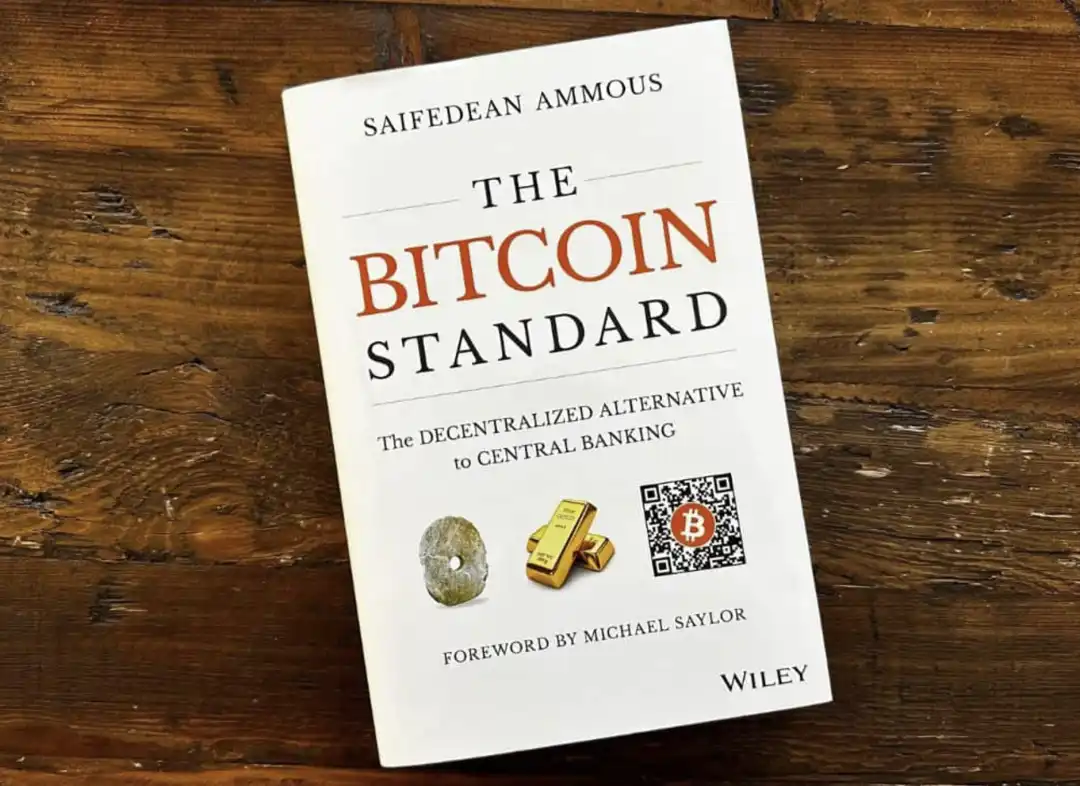
The author, Saifedean Ammous, holds a PhD in Economics from Columbia University, and his core argument is singular:
Bitcoin is a "hard currency" that is harder than gold.
Meanwhile, Michael Saylor's original recommendation on the book's promotional page reads:
"This book is a masterpiece. After reading it, I decided to buy $425 million worth of Bitcoin. It had the biggest impact on MicroStrategy's way of thinking, causing us to shift our balance sheet to a Bitcoin standard."
But there's a chapter in this book that's not about Bitcoin. It's about why silver can't become a hard currency.
Eight years later, silver has just reached a record high of $117, and the investment frenzy for precious metals continues. Even Hyperliquid and a number of CEXs have begun to launch contract trading for precious metals in different forms.
Often at times like these, someone will act as a whistleblower or a defector to warn of the risks, especially when everything else is rising except Bitcoin.
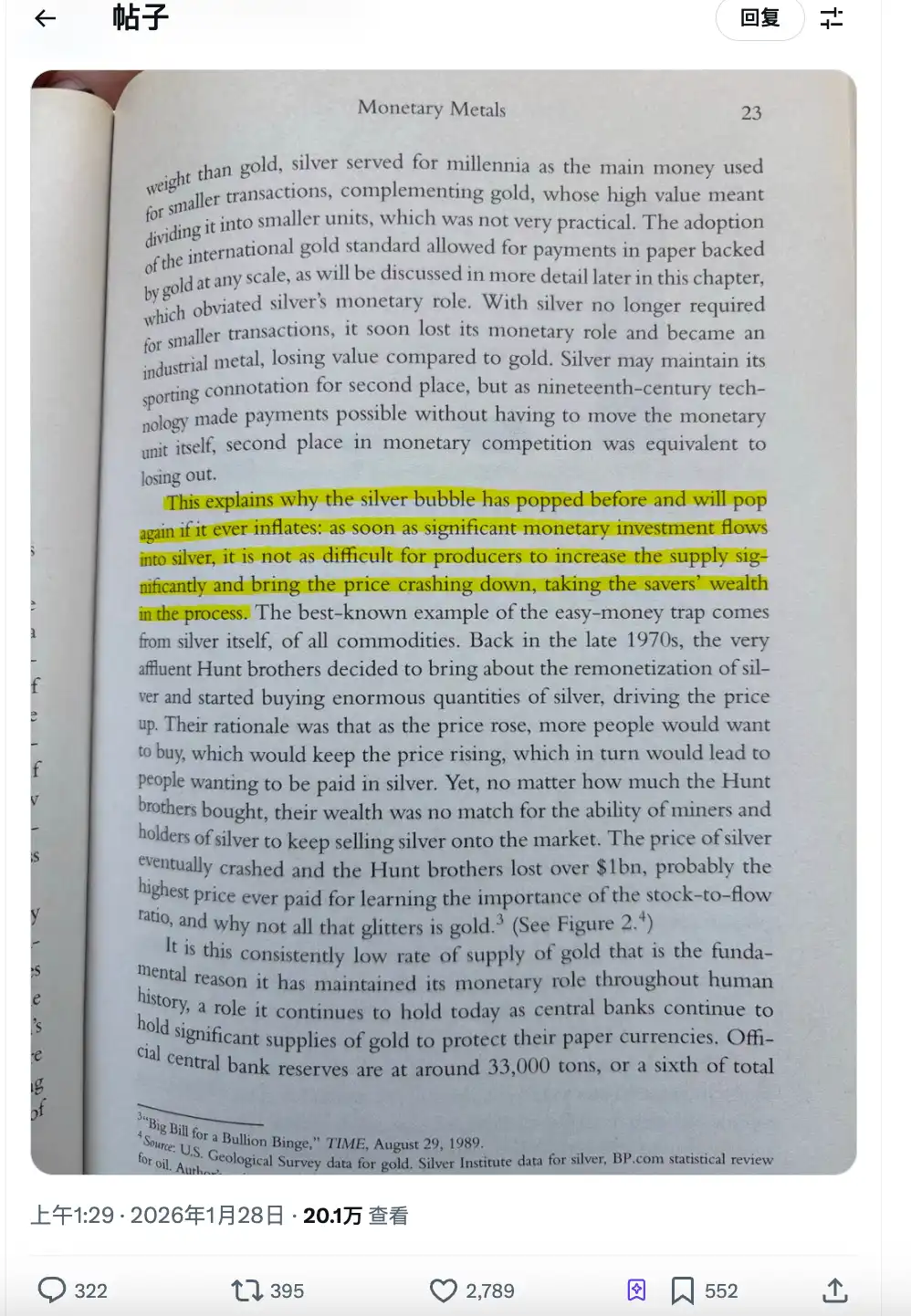
For example, a widely circulated post on encrypted Twitter today featured someone citing a screenshot from page 23 of this book, with the highlighted paragraph stating:
Every silver bubble bursts, and the next one will be no exception.
The history of silver speculation
Before you start criticizing, let's take a look at what this core argument is.
The core argument in this book is actually called stock-to-flow, the ratio of stock to flow. Bitcoin OGs should have heard of this theory to some extent.
In layman's terms, for something to become "hard currency,"The key is how difficult it is to increase production..
Gold is hard to find. Global above-ground gold reserves are approximately 200,000 tons, with annual new production of less than 3,500 tons. Even if the price of gold doubles, miners cannot suddenly find twice as much gold. This is called "supply rigidity."
Bitcoin is even more extreme. Its total supply is locked at 21 million coins, halving every four years, and no one can change the code. This scarcity is created through an algorithm.
What about silver?
The highlighted passage in the book roughly translates to:The silver bubble has burst before, and it will burst again. This is because once a large amount of capital flows into silver, miners can easily increase supply, driving down prices and causing savers' wealth to evaporate.
The author also gave an example: the Hunt brothers.
In the late 1970s, the Hunt brothers, Texas oil tycoons, decided to hoard silver in an attempt to squeeze the market. They bought billions of dollars worth of silver and futures contracts, driving the price from $6 to $50, which was a record high for silver at the time.
And then what? Miners frantically unloaded silver, trading platforms raised margin requirements, and silver prices collapsed. The Hunt brothers lost over $1 billion and eventually went bankrupt.

Therefore, the author's conclusion is:
Silver's supply elasticity is too high, making it unsuitable as a store of value. Every time someone tries to hoard it as a "hard currency," the market teaches them a lesson by increasing production.
When this logic was written in 2018, silver was $15 an ounce. Nobody cared.
Is this round of silver different?
For the above logic about silver to hold true, there is a prerequisite: if the price of silver rises, the supply can keep up.
However, the data from the past 25 years tells a different story.
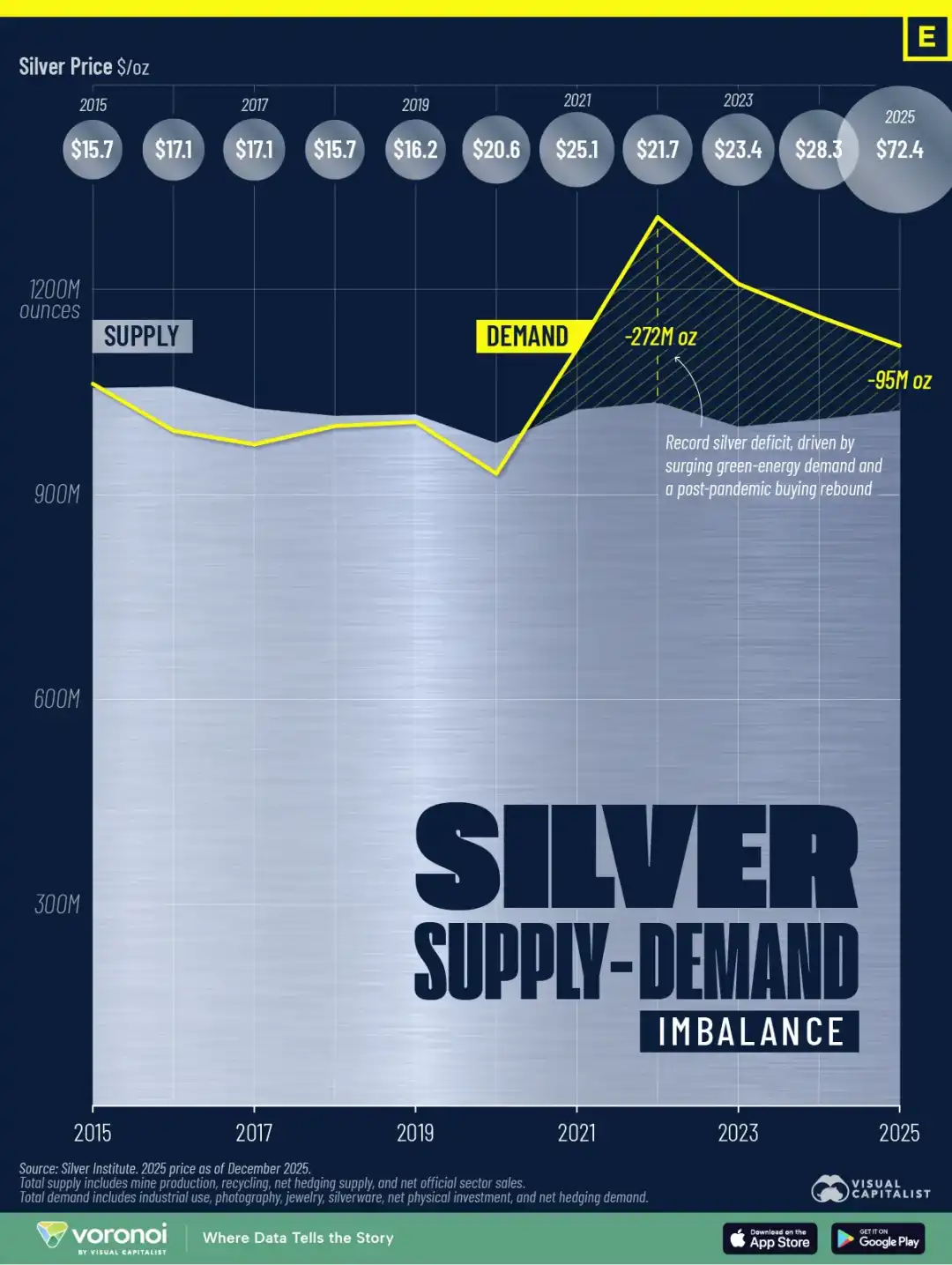
Global silver mining production peaked in 2016 at approximately 900 million ounces. By 2025, this figure has fallen to 835 million ounces. Prices have increased sevenfold, while production has actually shrunk by 7%.
Why does the logic of "increasing prices leads to increased production" no longer work?
One structural reason is that approximately 75% of silver is produced as a byproduct of copper, zinc, and lead mining. Miners' production decisions depend on the price of base metals, not silver. If the price of silver doubles but the price of copper doesn't rise, more mines won't open.
Another reason could be time. The cycle from exploration to production for a new mining project is 8 to 12 years. Even if construction started immediately, no new supply is expected before 2030.
The result is a supply deficit for five consecutive years. According to data from the Silver Institute, from 2021 to 2025, the global silver deficit will reach nearly 820 million ounces, which is almost equivalent to a whole year's global mining production.
Meanwhile, silver inventories are also bottoming out. The London Bullion Market Association's deliverable silver inventory has fallen to just 155 million ounces. Silver lending rates have surged from 0.3%-0.5% in normal years to 8%, meaning that some people are willing to pay an 8% annualized cost just to secure physical delivery.
There's another new variable. Starting January 1, 2026, China will impose export restrictions on refined silver, allowing only large state-owned enterprises with an annual production capacity exceeding 80 tons to obtain export licenses. Small and medium-sized exporters will be completely excluded.
In the Hunt brothers' era, miners and holders could manipulate the market by increasing production and selling off their holdings.
This time, the supply of ammunition may not be enough.
It's both speculation and a necessity.
When the Hunt brothers hoarded silver, it was a speculative currency. Buyers thought: the price will rise, so they'll hoard it and wait to sell.
The driving force behind the silver price surge in 2025 will be completely different.
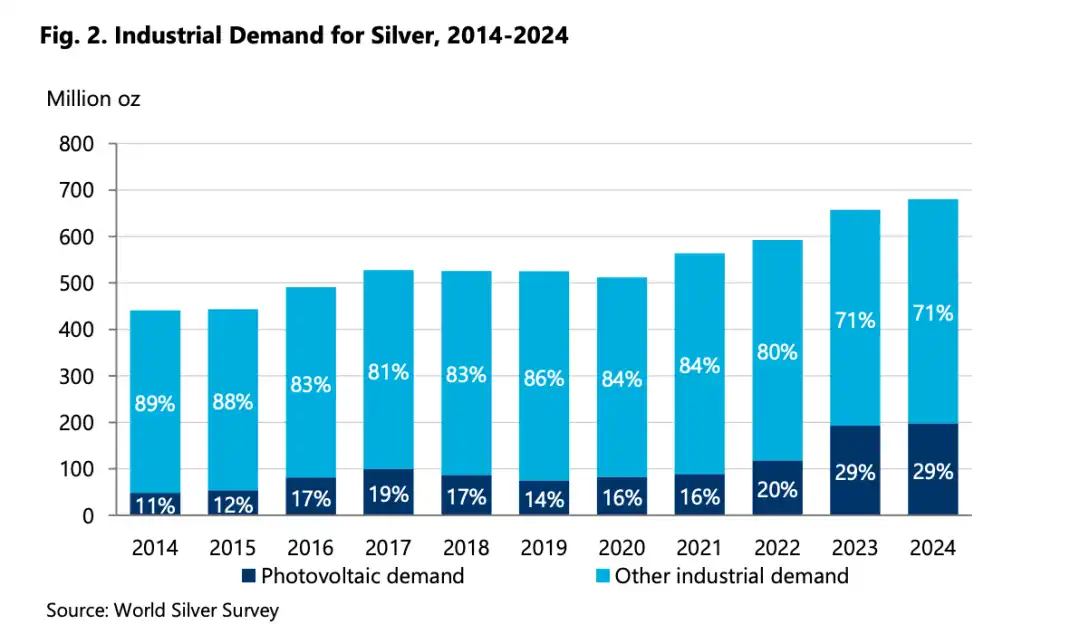
Let's look at some data first. According to the World Silver Survey 2025 report, industrial demand for silver reached a record high of 680.5 million ounces in 2024. This figure accounts for more than 60% of global demand.
What are industrial consumers buying?
PhotovoltaicsEach solar panel requires silver paste as a conductive layer. The International Energy Agency predicts that global photovoltaic (PV) capacity will quadruple by 2030. The PV industry is already the largest single industrial buyer of silver.
electric vehiclesA traditional gasoline-powered car uses approximately 15-28 grams of silver. An electric car uses 25-50 grams, with high-end models using even more. Silver is used in various parts, including the battery management system, motor controller, and charging interface.
AI and Data CenterIn servers, chip packaging, and high-frequency connectors, silver's electrical and thermal conductivity are irreplaceable. Demand in this area began to accelerate in 2024, with the Silver Institute specifically listing "AI-related applications" in its report.
In 2025, the U.S. Department of the Interior added silver to its "critical minerals" list. The last update to this list added lithium and rare earth elements.
Of course, the continued high price of silver will lead to a "silver-saving" effect, for example, some photovoltaic manufacturers are already reducing the amount of silver paste used per solar panel. However, the Silver Institute predicts that even taking into account the silver-saving effect, industrial demand will remain near record levels for the next 1-2 years.
This is actually a rigid demand, and it's a variable that Saifedean probably didn't foresee when he wrote "Bitcoin Standard".
A book can also provide psychological massage
The narrative of Bitcoin as "digital gold" has recently fallen silent in the face of real gold and silver.
The market dubbed this year the "Debasement Trade": a weaker dollar, rising inflation expectations, and geopolitical tensions drove funds into hard assets as a safe haven. But this wave of safe-haven funds chose gold and silver, not Bitcoin.
For Bitcoin extremists, this needs an explanation.
Therefore, the book mentioned above becomes a well-researched answer and defense of position: the current rise in silver prices is due to a bubble, and once it bursts, you will know who is right.
This is more like a narrative self-salvation.
When your assets underperform the market for an entire year, you need a framework to explain "why I'm still right".
Short-term price movements are unimportant; long-term logic is what matters. The logic behind silver is flawed, while the logic behind Bitcoin is sound, therefore Bitcoin is bound to outperform; it's just a matter of time.
Is this logic self-consistent? Yes. Can it be falsified? It's difficult.
Because you can always say "not enough time".
The problem is, the real world waits for no one. Those guys in the crypto world who are still holding onto their Bitcoin and altcoins are really anxious.
The Bitcoin theory written 8 years ago cannot automatically cover the reality that it will not rise 8 years later.
Silver is still surging, and we sincerely wish Bitcoin good luck.