





Author:Cold Wind Meta
author:0xKira
Foreword
In the ever-evolving landscape of cryptography and blockchain, few innovations have garnered as much attention as zero-knowledge (ZK) proofs. Once an obscure academic concept confined to computer science theoretical papers, zero-knowledge proofs have rapidly moved from theoretical discussions to the mainnet, becoming the cornerstone of next-generation cryptographic infrastructure.
The core of zero-knowledge proofs lies in challenging a long-held assumption in digital systems: verification requires the exposure of information. Whether logging into an application, verifying identity, or confirming a transaction, we have historically needed to disclose certain information to gain trust. Zero-knowledge proof technology breaks this trade-off, enabling us to prove facts about identity, data, or computation without revealing underlying information.
Beyond privacy protection, zero-knowledge proofs enable scalability, interoperability, and trustless verification globally. From ZK rollups that scale blockchain throughput to privacy-preserving identity and compliance systems, zero-knowledge proofs are redefining the possibilities of the crypto space.
summary
Zero-knowledge (ZK) proofs can verify information such as identity, balance, or transaction validity without revealing the underlying data.
Although zero-knowledge proof technology was first proposed in the 1980s, it has only recently become practical due to advancements in computing, cryptography, and blockchain technologies.
ZK proofs enable private transactions, decentralized identity, DAO voting, and cross-chain interoperability, while scaling Ethereum by packaging thousands of transactions into a single proof through ZK Rollups.
Despite its higher computational cost, the ZK rollup algorithm offers instant finality, lower cost, and stronger security, making it superior to Optimistic-based solutions.
What is zero-knowledge proof?
Zero-knowledge (ZK) proofs are a cryptographic method that enables one party (the prover) to prove a statement to another party (the verifier) that it is true without revealing why the statement is true or any additional information.
For example, Alice wants to prove to Bob that she knows the code to a hidden door in a cave, but she can't just tell him the code. She enters the cave, opens the door, and then reappears on the other side. Bob can't see how she does it, but he knows she definitely knows the code.
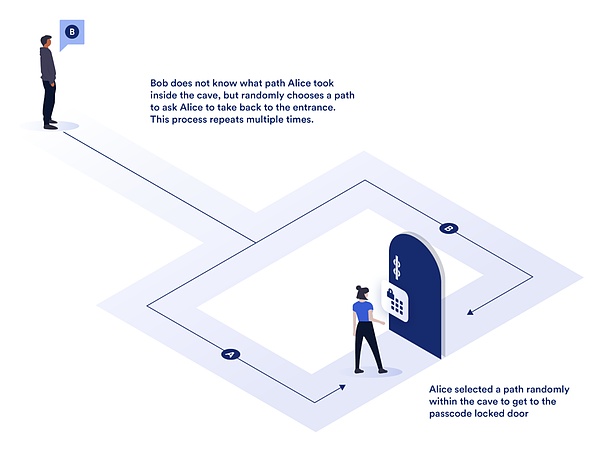
A classic analogy for zero-knowledge proofs – Chainlink
Traditionally, verification requires the disclosure of some information: such as identity information, passwords, or data. Zero-knowledge proofs disrupt this model, proving identity, authenticity, or ownership without exposing the data itself.
In digital systems, this means you can:
You can prove you are 18 years of age or older without revealing your birth date.
Proving you have enough funds without revealing your wallet balance
Proving the validity of a transaction without disclosing its contents.
This ability to "provide without revealing information" is the foundation of systems that maintain privacy, security, and transparency, and zero-knowledge proofs can precisely achieve both of these characteristics.
How do they work?
Zero-knowledge proofs rely on esoteric mathematical structures and cryptographic primitives, but conceptually they can be reduced to three fundamental properties:
CompletenessIf the statement is true, an honest prover can convince the verifier that it is true.
Reliability (Soundness)If a statement is false, no cheating prover can convince the verifier that the statement is false.
Zero-KnowledgeThe verifier will not receive any other information besides knowing that the statement is true.
In fact, there are several types of zero-knowledge proofs, but the current discussion focuses on two main types: interactive and non-interactive zero-knowledge proofs.
In early designs, zero-knowledge proofs were interactive. Proofers and verifiers engaged in a two-way dialogue, with verifiers posing random challenges and provers providing proofs in response, collectively building confidence in the truth of a statement. While this model is theoretically sound, in a blockchain environment, real-time interaction between the parties is often difficult, making it inefficient.
To make them more practical, cryptographers developed non-interactive zero-knowledge proofs (NIZKs), which require only a single message from the prover to the verifier. The most famous of these are zk-SNARKs, which can generate extremely compact proofs and complete verification within milliseconds. Another variant is zk-STARKs, which require no trusted setup and provide a post-quantum security level.
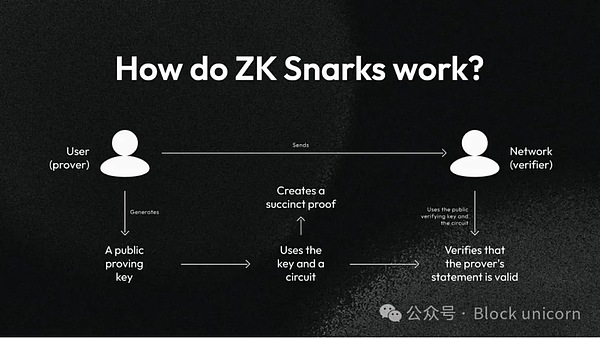
How zk-SNARKs work – Midnight Network
Essentially, these systems allow provers to generate a mathematical "fingerprint" of a valid computation. Verifiers can then check that fingerprint without having to recalculate the entire computation. This is precisely why they are so powerful in blockchain scaling: thousands of transactions can be verified quickly and at low cost by checking only a single cryptographic proof.
When was zero-knowledge proof invented?
Zero-knowledge proofs can be traced back to the mid-1980s, when researchers Shafi Goldwasser, Silvio Micali, and Charles Rackoff introduced the concept in their seminal paper, “The Knowledge Complexity of Interactive Proof Systems” (1985).
Their early theoretical models laid the foundation for cryptographic innovations over the following decades, but zero-knowledge proofs did not become practical until the 2010s, thanks to improved computational efficiency and the rise of blockchain technology.
Launched in 2016, projects like Zcash were among the first to deploy zero-knowledge proofs on a large scale, using zk-SNARKs to implement private transactions on a public ledger. Since then, zero-knowledge proof technology has seen significant advancements, becoming more efficient, generating proofs faster, and new frameworks (such as zk-STARKs, Halo, and PLONK) have emerged, making it easier for developers to use and more suitable for scaling real-world systems.
What are the applications of zero-knowledge proofs in the field of cryptography?
The most intuitive and well-known application scenario is privacy-preserving transactions. Zero-knowledge proofs allow users to transact on public blockchains without exposing sensitive information such as transaction amounts or counterparties. Zcash pioneered this technology by introducing a "shielded transactions" mechanism, protecting user privacy while maintaining verifiable on-chain integrity. Building on this, projects like Tornado Cash, Aztec, and Railgun have extended zero-knowledge proof technology to Ethereum, enabling private smart contract interactions and confidential DeFi transactions.
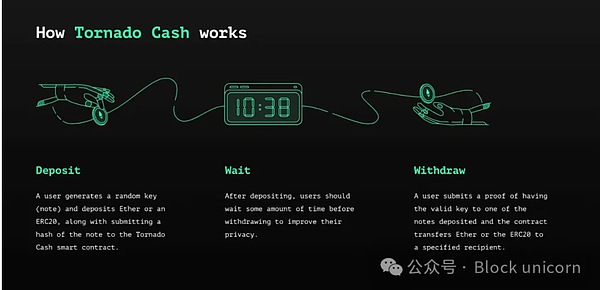
How Tornado Cash Works - Elliptic
Beyond privacy protection, zero-knowledge proofs are revolutionizing digital identity and regulatory compliance. They enable selective disclosure, allowing users to prove specific facts about themselves without revealing their personal data. For example, a user can prove they have passed KYC verification without revealing their name, or confirm they are not on a sanctions list without providing identification information. This principle forms the basis for emerging zero-knowledge identity systems such as Worldcoin's Proof of Person, Polygon ID, and zkPass.
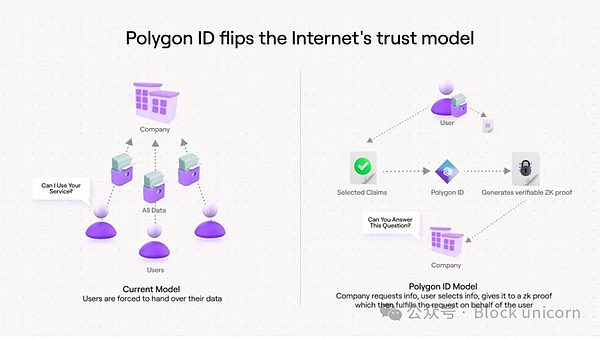
Polygon ID: An Identity System Supporting Zero-Knowledge Proofs - Polygon
Zero-knowledge proofs also have powerful applications in voting and governance. In decentralized autonomous organizations (DAOs), they can facilitate anonymous yet verifiable voting processes, ensuring transparent results while protecting the privacy of individual voters. This helps reduce the risk of coercion or retaliation, encourages more honest participation in collective decision-making, and thus strengthens the democratic principles of decentralized governance.
Another advantage of zero-knowledge proofs lies in cross-chain verification. In multi-chain environments, traditionally, establishing trust between different blockchains requires intermediaries or complex bridging mechanisms. Zero-knowledge proofs offer a more elegant solution: a proof generated on one chain can demonstrate the validity of its state, while another chain can independently verify that proof. This achieves trustless interoperability, enabling different blockchains to communicate securely without relying on centralized validators.
ZK technology is also enhancing Ethereum's scalability through ZK Rollups. By packaging thousands of transactions into a single cryptographic proof, these Rollups significantly reduce on-chain data load while ensuring security. The result is faster, lower-cost, and more efficient transaction processing, laying the foundation for Ethereum to handle large-scale applications without compromising its decentralized nature.
ZK Rollup Explained
Of all the zero-knowledge proof-based applications, ZK rollups are undoubtedly the most revolutionary. They address one of the biggest challenges in the cryptocurrency space: blockchain scalability.
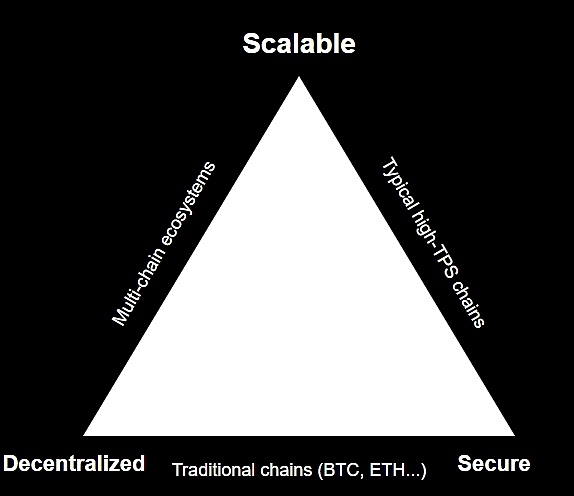
Since the inception of blockchain technology, all blockchains have faced the blockchain trilemma: they can only achieve two of the three core attributes of security, scalability, and decentralization. While blockchains like Ethereum are secure and decentralized, they remain slow and expensive. Every transaction must be verified by all nodes, creating a bottleneck, limiting throughput, driving up gas fees, and severely reducing blockchain usability.
A rollup is a Layer-2 solution that executes transactions off-chain and then publishes the aggregated information back to the main chain or Layer-1 (usually Ethereum). Rollups are mainly divided into two types: Optimistic rollups and ZK rollups.
In a ZK Rollup, hundreds or thousands of off-chain transactions are bundled together. A prover generates a zero-knowledge proof (also known as a validity proof) showing that all bundled transactions comply with the blockchain's rules. This single proof is then submitted to the main chain, which can quickly and reliably verify it.
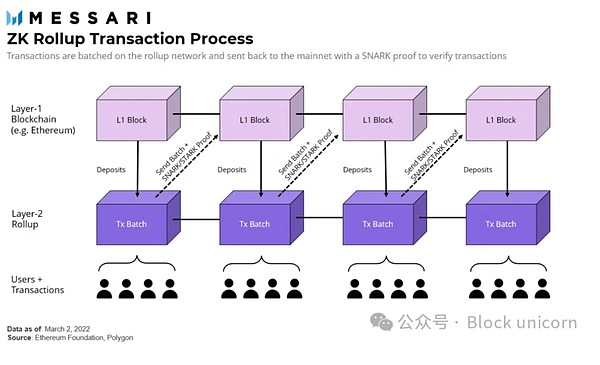
How ZK Rollups Work - Messari
This design significantly reduces the amount of data and computational burden on Layer-1, while maintaining the same security guarantees as processing each transaction individually, thereby eliminating the speed and scalability bottlenecks of Layer-1.
Some representative ZK rollup projects include:
zkSync EraDeveloped by Matter Labs, it achieves fast finality using zk-SNARKs.
StarkNetBuilt on zk-STARKs, emphasizing scalability and transparency.
Polygon zkEVMThe Ethereum Virtual Machine (EVM) is a zero-knowledge implementation that makes it fully compatible with existing smart contracts on Ethereum.
LighterA perpetual DEX platform built on a custom ZK rollup, using zk-SNARKs, specifically Plonky2.
Advantages of ZK Rollup
By compressing thousands of transactions into a single cryptographic proof, ZK rollups can significantly increase throughput, enabling blockchains like Ethereum to handle more activity without sacrificing decentralization or security.
Security is another key advantage. Unlike Optimistic rollups that rely on economic incentives and a week-long challenge period to detect fraud, ZK rollups use mathematical validity proofs to guarantee correctness in advance. Once the proof is verified on-chain, the underlying transactions are final and immutable, thus eliminating latency and uncertainty.
This also means faster confirmation speeds. Transactions in ZK rollups are settled immediately after their corresponding proofs are verified, allowing users to obtain the final result almost instantly compared to the waiting times common in Optimistic systems.
Cost-effectiveness is another major advantage. Because ZK Rollups submit only a very small amount of data to the Layer-1 blockchain, gas fees are significantly reduced, making it cheaper for users and applications to run on Ethereum.
Even more exciting is that ZK rollups open the door to enhanced privacy. Because they are built on zero-knowledge cryptography, confidentiality can theoretically be directly embedded into the rollup itself, enabling large-scale, private, and verifiable transactions.
The main limitation at present lies in the computational requirements. Generating zero-knowledge proofs still consumes significant resources, requiring powerful hardware and advanced cryptographic techniques. However, continuous progress, particularly in hardware acceleration, circuit design, and recursive proofs, is steadily reducing these costs, making each generation of ZK rollups more efficient.
Comparison with Optimistic Rollup
Optimistic rollups, such as Arbitrum and Optimism, follow a different philosophy. They assume all off-chain transactions are valid. Only when this assumption is challenged will the system require a "fraud proof" to verify the dispute, a process that typically takes about a week. This model works well in practice but causes delays in the final confirmation of transactions and relies on incentive mechanisms to encourage participants to identify and report invalid activity.
ZK rollups, on the other hand, come with a zero-knowledge proof of validity for each batch of transactions, which mathematically confirms their correctness before they are written to the main chain. This provides instant finality and stronger security, but also brings higher technical complexity and a greater amount of computation.
Essentially, these two models represent different trade-offs. Optimistic Rollup is easier to implement and currently dominates the Ethereum Layer-2 space due to its simplicity and full compatibility with the Ethereum Virtual Machine (EVM). ZK Rollup is more complex and computationally intensive, but it offers faster settlement speeds, lower costs, and the potential for built-in privacy.
in conclusion
Zero-knowledge proofs represent a paradigm shift in how we address trust, privacy, and verification in digital systems. This abstract cryptographic theory, which originated in the 1980s, has become one of the most promising technologies driving the development of next-generation decentralized infrastructure.
In the cryptocurrency space, zero-knowledge proofs power private transactions, decentralized identity, cross-chain interoperability, and most importantly, scalable rollup architectures that maintain Ethereum-level security while exponentially increasing throughput. Their applications extend beyond blockchain to fields such as finance, artificial intelligence, and data verification.
Although the application of zero-knowledge proofs is still in its relatively early stages, its development trajectory is already clear. Zero-knowledge proofs are transforming from a novel technology in the field of cryptography into an essential component of infrastructure construction. If blockchain is to scale to billions of users while ensuring privacy and decentralization, then zero-knowledge proofs may very well be the key to unlocking this future.